
Offline Data Collection for Service Businesses
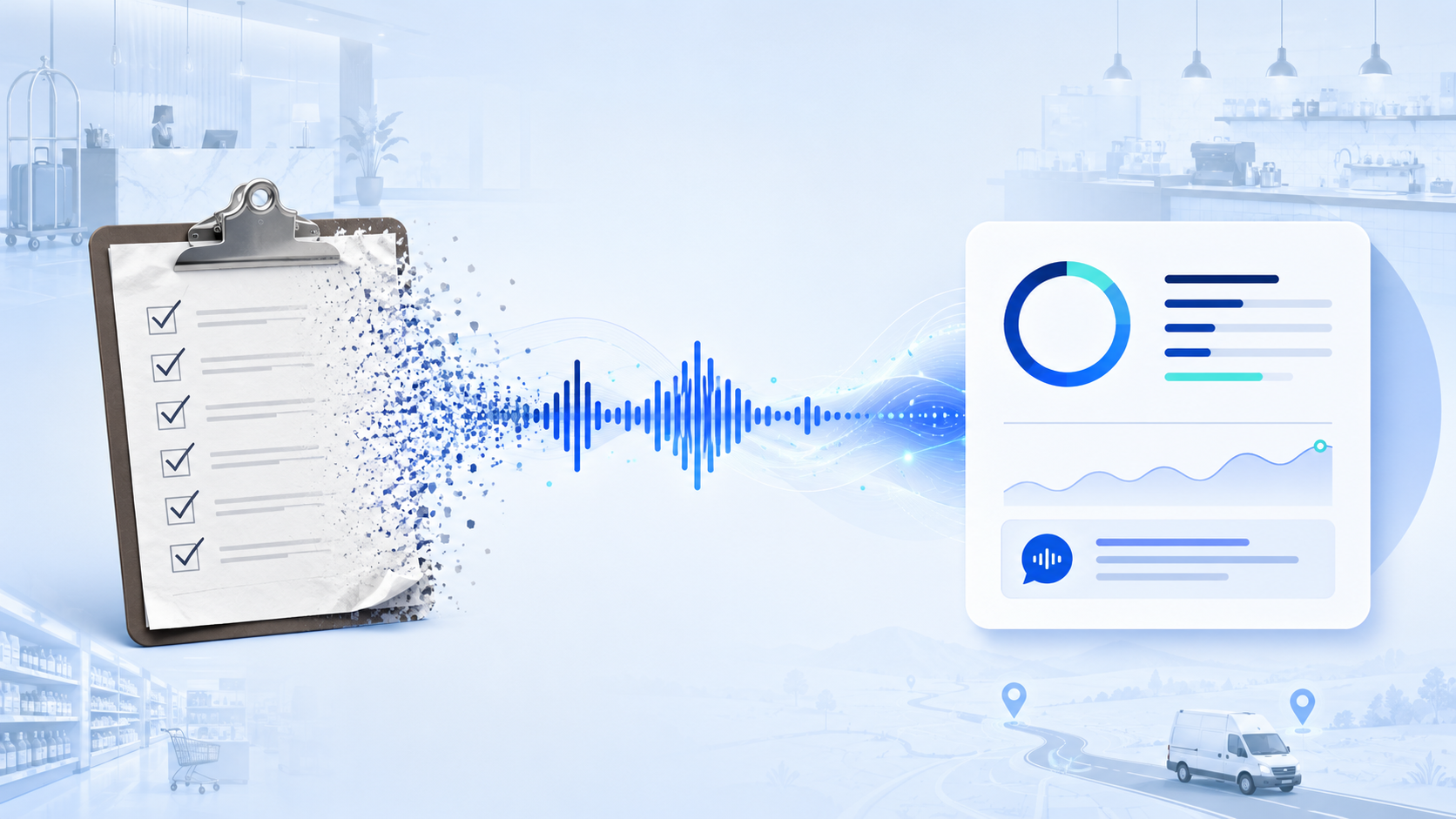
Digital businesses know where a customer clicked, where a session dropped, and which offer was converted. Service businesses generate just as much signal through offline customer experience, but that signal lives away from the screen: in hotel lobbies, restaurant lines, retail aisles, casino floors, healthcare facilities, and field operations routes. Even in retail, e-commerce accounted for only 16.9% of total U.S. retail sales in Q1 2026, which means most commercial activity still happens outside purely digital channels.
The tools have improved. Mobile data collection apps, smartphones, tablets, QR codes, and voice interfaces make offline data entry easier than clipboards. But easier capture is not the same as better intelligence. A checklist confirms that a standard was missed; it rarely explains why. Better offline data collection connects the score to the story behind it.
The Problem With Paper Forms And Static Audits
Most operators still depend on paper forms, static surveys, audits, or manager notes. Those tools are familiar, but they create gaps. Survey research also has a known nonresponse problem: the people who respond may differ from the people who do not.
First, paper creates lag. A field staff member or mystery shopper may capture an issue on site, but leadership does not see it until someone completes data management work later. Second, paper creates data loss: notes get skipped, handwriting is unclear, and context disappears before it reaches operations.
Static digital forms improve the process, but they still flatten reality. They ask fixed question types and assume every situation fits the same structure. That may work for compliance, inspections, basic case management, or a single question type. But when leaders need to understand why guest experiences, service models, or frontline workflows are breaking differently across locations, fixed forms often miss the context that matters.
What Better Offline Data Needs To Capture
The best programs do not collect more fields for the sake of it. They collect the context that helps leaders decide what to fix next.
For a restaurant group, that might mean learning why a new service step breaks on Saturdays. For a hotel group, it might mean finding the handoff where guest preferences disappear. For a retailer, it might mean learning that associates skip a loyalty prompt because the POS flow slows checkout.
Because customer experience unfolds across a journey, not one isolated interaction, useful offline data should answer five questions:
- What happened?
- Where did it happen?
- Why did it happen?
- Who is affected?
- What action would the people closest to the work recommend?
The first two are usually available somewhere. The last three live in conversations with frontline teams, customers, guests, field staff, and managers, and sometimes outside researchers or mystery shoppers.
Why Mobile Access Is Only The Starting Point
Offline environments are messy. The internet connection may be weak in a basement kitchen, rural property, warehouse, stadium, or remote area. Teams may work in remote locations where internet connectivity is unreliable. Any offline data collection app needs offline mode, mobile devices, clean syncing, and basic safeguards against duplicate offline data entries.
But access alone does not solve the problem. A mobile data collection app can run on a tablet, support basemaps for routes, and protect data security, yet still produce shallow insight if it only asks people to check boxes.
The bigger question is not whether teams can collect offline data. It is whether that data gives leaders enough context to make better decisions. Structured offline forms can help teams standardize how information gets captured in the field. But service operators do not just need cleaner forms. They need to understand what the guest said, what the employee noticed, why the process failed, and what would make the fix stick.
How Voice Turns Offline Feedback Into Operational Intelligence
Voice interviews are often the better interface for offline teams because it fits the pace of physical work. A server can explain a bottleneck after a shift. A front desk agent can describe the moment a guest became frustrated. A store associate can share why customers abandon baskets. A mystery shopper can describe the emotional texture of check-in before the memory fades.
Voice also gives AI more to work with than a rating or text box. That is where AI-moderated interviews can help: they preserve open-ended detail while making the feedback easier to analyze at scale. Instead of asking only, “Was the room ready?” a voice-first system can ask follow-up questions, apply conditional logic, clarify the root cause, and identify patterns across locations.
That is the difference between raw feedback and operational intelligence. Leaders need themes, root causes, severity, location patterns, and recommended actions. They also need evidence trails that preserve data integrity, so every conclusion can be traced back to real voices.
What To Look For In An Offline Data Collection Platform
Service businesses should evaluate mobile data collection apps by asking whether the platform improves decisions, not just form completion.
Look for:
- Mobile-first participation across smartphones, a smartphone, tablets, and shared devices
- Offline mode for remote areas or inconsistent internet connections
- Voice and text collection for frontline and customer conversations
- Multilingual access for distributed teams
- Flexible question types, adaptive prompts, and conditional logic
- Data validation that catches incomplete or inconsistent responses
- Strong data security and permission controls
- Segmentation by location, role, shift, region, touchpoint, or case management need
- Dashboards that summarize real-time data without hiding the underlying evidence
- Analysis that turns data collection into recommendations
Many tools can digitize a paper form. Fewer help operators understand why execution varies across 50, 100, or 500 locations.
How Arbor Helps Service Businesses Collect Better Offline Data
Arbor is built for the gap between physical-world operations and executive decision-making. Umi, Arbor’s AI researcher, runs voice-based interviews with frontline employees, customers, guests, and mystery shoppers, then turns those conversations into structured intelligence.
Instead of treating offline research as a form, Arbor treats it as a research process. Teams design questions around a business outcome, reach people through low-friction links or QR codes, conduct adaptive interviews, analyze conversations by theme and root cause, and deliver executive-ready recommendations.
A traditional form can tell you whether a location followed the playbook. Arbor helps leaders hear what the frontline, guest, or shopper said before the trend became obvious.
The Future Of Offline Collection Is Context
Service businesses do not lose revenue only because something went wrong. They lose revenue because the reason stayed hidden long enough to repeat.
The next generation will not look like longer audits, more paper forms, or a better spreadsheet. It will look like real conversations, captured continuously, synthesized into clear intelligence, and tied back to the business outcomes leaders own.
Ready To Turn Offline Conversations Into Intelligence?
Arbor helps multi-location operators hear from the people closest to the work and turn those conversations into executive-ready insight. Meet Umi to see how frontline and customer conversations can become your next operating advantage.
FAQs
Q: What is offline data collection?
Offline data collection is the process of capturing information from physical-world environments such as stores, restaurants, hotels, venues, plants, healthcare settings, and field operations, often with mobile devices that can work even when an internet connection is unreliable.
Q: What is the difference between mobile data collection and offline data collection?
Mobile data collection describes how data is captured, usually through smartphones, tablets, or a mobile app. Offline collection focuses on capturing data in physical environments, including places with limited internet connectivity or remote locations.
Q: Why do checklists miss important offline data?
Checklists confirm whether a standard was met, but they rarely explain the context behind execution. They can show that a step was skipped, but not why the team skipped it, whether the issue is isolated, or what would fix it.
Q: How does AI improve offline data collection?
AI can conduct adaptive interviews, ask follow-up questions, transcribe responses, identify themes, compare locations, and summarize findings into recommendations. The value is turning scattered offline conversations into usable business intelligence.