
Generative AI Market Research: A Guide for Leaders
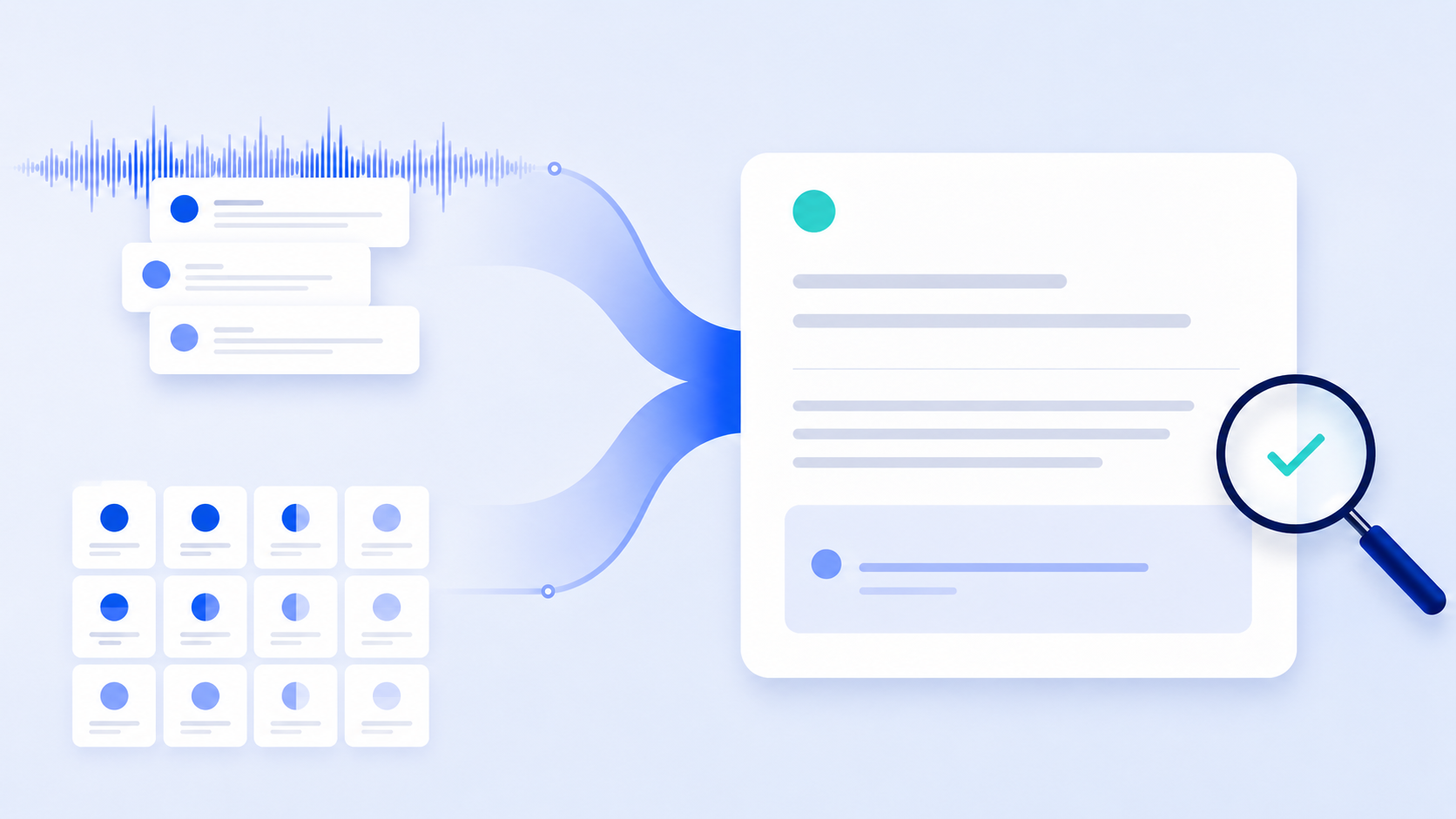
Generative AI is changing both how market research is conducted and how qualitative data is analyzed. Research teams can draft questions, moderate interviews, translate conversations, classify unstructured data, and create findings faster. But the goal is greater depth and scale without losing rigor. Surveys, AI interviews, and human-moderated focus groups answer different questions. Strong generative AI market research chooses the right method and preserves the evidence behind every conclusion.
What Is Generative AI Market Research?
Generative AI market research applies large language models and related machine learning systems across research design, data collection, data analysis, insight generation, and reporting. Unlike traditional automation, which follows fixed rules, generative AI can interpret open-ended language, adapt follow-up questions, and produce new summaries or recommendations from source material.
The underlying technology may include large language models, natural language processing, conversational AI, sentiment analysis, and predictive analytics. General-purpose AI assistants can help brainstorm survey questions, but research-grade systems need additional controls for sampling, moderation, segmentation, privacy, and source traceability.
This use case is different from reading a generative AI market report about market size, CAGR, or broad market trends. It is also distinct from technical applications such as GANs, generative adversarial networks, medical imaging, a digital twin, or synthetic data development. The focus here is using AI to understand real people, consumer behavior, workflows, and decisions.
How Generative AI Is Used in Market Research
Generative AI can support the full research lifecycle:
- Drafting research objectives, interview guides, and survey questions
- Conducting voice or text AI-moderated interviews
- Generating adaptive follow-up questions based on each answer
- Transcribing and translating conversations
- Coding open-ended responses and identifying themes
- Segmenting findings by role, location, behavior, or customer type
- Producing visualizations, summaries, and recommended actions
A model can still misclassify a theme or flatten an important contradiction, so outputs need auditable source conversations and human judgment.
Generative AI Interviews vs. Traditional Surveys
| Research Need | AI Interview | Survey |
|---|---|---|
| Understand why someone feels a certain way | Strong fit | Limited |
| Collect standardized numerical data | Possible, but secondary | Strong fit |
| Explore an emerging issue | Strong fit | Difficult without known answer choices |
| Reach a large sample quickly | Strong fit | Strong fit |
| Ask personalized follow-ups | Strong fit | Limited |
| Benchmark results over time | Useful with consistent structure | Strong fit |
Use generative AI interviews when the team needs explanations, stories, and examples; when the issue is exploratory; or when participant context varies significantly. They are especially useful for customer journeys, operational workflows, and decision-making because the interviewer can ask, “What happened next?” or “Why did that matter?”
Use surveys when the objective is measurement rather than exploration. Surveys are better for standardized benchmarks, representative comparisons, and short repeatable trackers where the answer choices are already understood.
The strongest programs often combine both. A survey can locate a pattern, while interviews explain it. Teams can follow quantitative segmentation with qualitative exploration, add an AI conversation after an important rating, or validate interview themes with a broader sample.
Benefits of Generative AI Market Research
Generative AI makes qualitative research more continuous and accessible. Teams can conduct more conversations, maintain consistent interview structure, analyze open-ended feedback faster, and support multilingual participation. Leaders can review themes with direct quotes sooner, which is valuable for marketing strategies, service changes, launches, and digital transformation programs.
For distributed businesses, AI research can also capture perspectives that conventional panels miss. Frontline employees often know why performance differs across locations. They also help teams understand what customers actually need during real-world experiences.
Risks, Limitations, and Human Validation
Poorly designed generative AI market research can scale weak research just as quickly as strong research. Common risks include leading questions, biased samples, inaccurate theme classification, over-summarization, and recommendations presented without evidence.
Synthetic respondents deserve particular caution. They may help test a discussion guide or simulate edge cases, but they should not be treated as substitutes for real participants when the goal is to understand lived experience. Similarly, predictive models can identify possible patterns, but they cannot replace direct evidence about why a person acted or felt a certain way.
Governance matters as much as model performance. Research teams should establish consent, retention, access, and review rules; use the NIST AI Risk Management Framework to structure risk controls; and follow the OECD principles for trustworthy AI. Studies involving Research teams should also follow the Federal Trade Commission’s privacy and security guidance when collecting, storing, and using participant data.
Human researchers should review the design before launch, audit interview performance, verify major themes against transcripts, challenge unsupported interpretations, and add industry context. This is especially important in healthcare, where research may touch sensitive experiences even when it has nothing to do with clinical medical imaging.
How to Evaluate a Generative AI Market Research Platform
Evaluate platforms on more than their ability to generate summaries. Look for interview quality, adaptive follow-ups, voice and text support, multilingual participation, research-design controls, segmentation, transcript access, privacy, security, and executive-ready reporting.
Transparency is essential. A useful platform should show the evidence behind each theme, preserve source conversations, and separate participant statements from generated recommendations.
Participant experience matters. Research fails when people cannot access or trust it. This is one reason offline customer experience needs better data: the people closest to physical customer journeys are often the hardest to reach through email-based research.
Generative AI Market Research for Frontline and Customer Intelligence
Frontline research extends beyond a traditional consumer panel. It can include employees who do not sit at desks, customers responding during or immediately after an experience, and mystery shoppers evaluating specific touchpoints.
The same program can combine customer, employee, and mystery shopper perspectives to reveal where brand promise and day-to-day delivery differ. For example, a customer may report a confusing check-in, while an employee explains that reservation notes do not reach the property system. That connection is more actionable than either data point alone.
Arbor combines AI-moderated conversations with expert-supported synthesis, helping teams turn real-world conversations into findings and recommendations for senior leaders. The objective is not a larger pile of transcripts. It is evidence leaders can use.
Build a Human-Validated AI Research Program
Start with one important business question. Choose interviews, surveys, or a mixed-method design based on the decision that must be made. Define participant groups and segmentation before launch, establish quality controls, and assign a decision owner who will act on the findings.
Then keep listening. One study can explain the current problem; a continuous program shows whether the intervention worked, what changed, and where a new issue is emerging.
Final Thoughts: Scale Qualitative Research Without Sacrificing Context
Generative AI market research works best when AI expands the reach of rigorous research rather than replacing research discipline. The winning model combines adaptive conversations, structured analysis, direct evidence, and human validation.
Arbor helps teams conduct scalable customer and frontline research with consulting-level synthesis and software-level continuity. Book a demo to turn customer, employee, guest, and mystery shopper conversations into evidence leaders can act on.
FAQs
Q: Can generative AI replace market researchers?
No. It can automate moderation, coding, translation, and first-pass synthesis, but humans are still needed to design the study, evaluate evidence, identify bias, and translate findings into realistic decisions.
Q: Are AI interviews better than surveys?
They are better for exploratory questions and personalized follow-ups. Surveys remain stronger for standardized measurement, benchmarking, and large representative comparisons.
Q: Can synthetic respondents be used in market research?
They can support guide testing or scenario exploration, but they should not replace real participants when the goal is to understand actual behavior, needs, or experiences.
Q: What is the best first use case?
Start with a high-value question where existing metrics show what happened but not why. Customer friction, workflow breakdowns, launch adoption, and location-level variance are strong candidates.