
Field Operations Management: See Floor-Level Reality
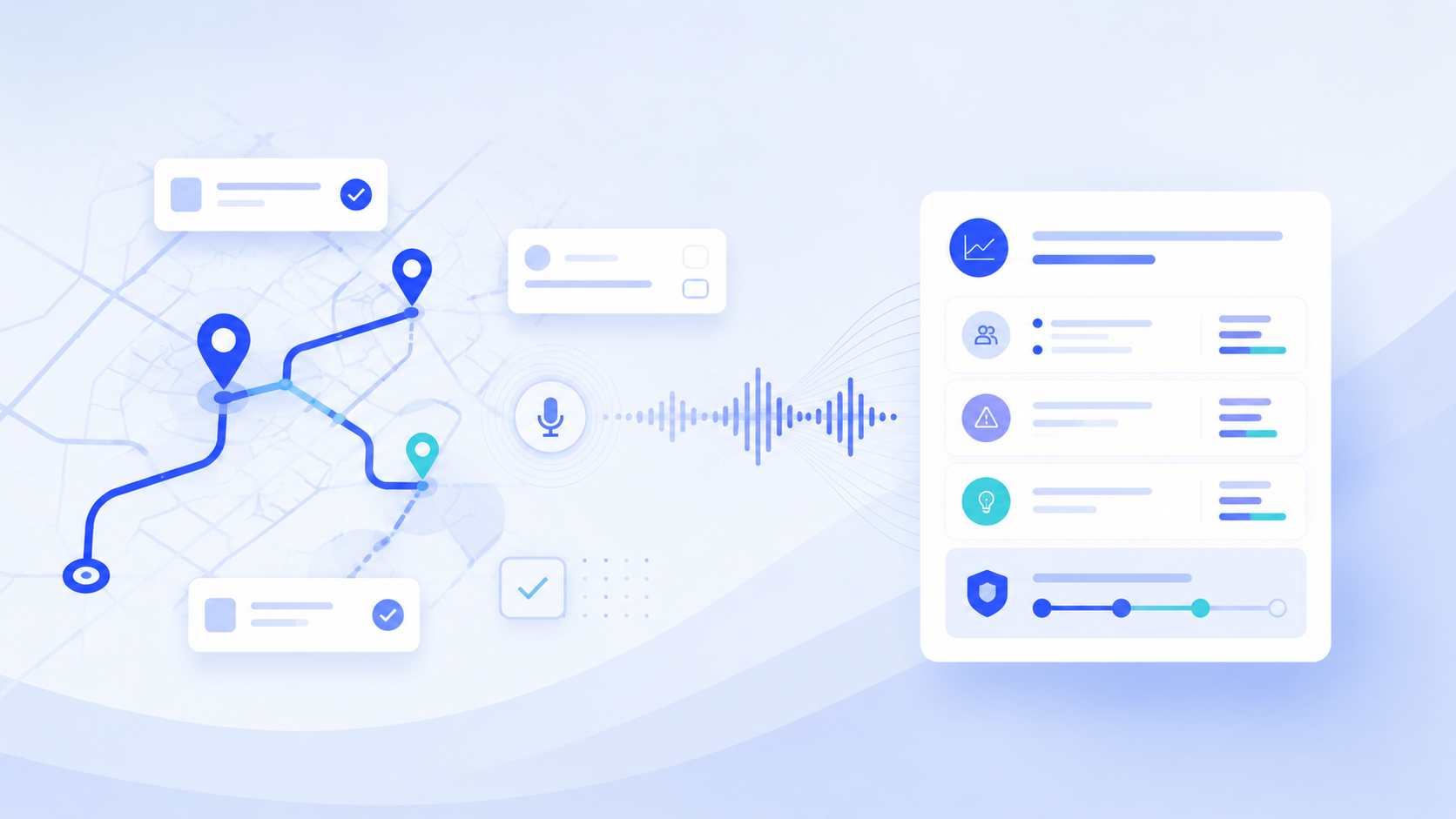
Field operations management is supposed to give leaders control over work that happens away from headquarters. A field operations manager needs to know whether technicians arrived on time, whether crews followed the job plan, whether customers were satisfied, and whether the next shift has the parts, staffing, and context to succeed.
Most field operations teams already have data. They have work order management, schedules, route planning, CRM notes, ERP records, inventory management, GPS tracking, mobile forms, and project management dashboards. In field service management, that operational stack is essential. It helps coordinate people, assets, jobs, communication, and customers.
But dashboards still miss the most important question: what is actually happening on the floor, in the truck, at the job site, or inside the customer interaction?
That is the gap Arbor calls the intelligence gap: the distance between what operational systems can measure and what frontline teams know from doing the work every day. The people closest to the work often understand the root cause before it appears in a report.
Why Field Operations Management Breaks Down Across Locations
The hardest part of field operations management is not assigning work. It is understanding variance.
One field operation may run cleanly because the supervisor knows every workaround. Another team may look productive while missing service levels, skipping preventive maintenance, or creating repeat visits that hurt customer satisfaction. A third location may hit its numbers while relying on unsafe shortcuts that have not yet shown up in safety data.
Field operations management often depends on reports that arrive after the moment has passed. GPS tracking can show where a technician went. It cannot explain why a stop took twice as long. A CRM can show that a customer escalated. It cannot explain whether the issue came from poor onboarding, a missing part, confusing instructions, an access constraint, weak real-time communication, or a process that does not match what happens in the field.
That is why field operations leaders need a second layer of intelligence: structured conversations with the people closest to the work.
What Traditional Field Data Can And Cannot Tell You
Field operations data is strongest when the question is objective. Did the crew arrive? Was the job closed? Was the part scanned? Did the route finish on time? Was the inspection completed? Did the team meet the service level agreement?
These metrics matter for operational efficiency, quality control, customer experience, and operational costs. But they rarely explain the cause behind the metric.
A work order management system can show repeat dispatches, but the frontline may know the real problem: the diagnostic checklist does not match the asset in the field. ERP data can show delayed parts, but the technician may know that the mobile inventory process is wrong. GPS tracking can show route drift, but field operatives may know that the planned route ignores a gate code, loading dock rule, traffic pattern, or customer availability window.
Better field operations management connects the score to the story. It asks people in the field what slowed them down, what customers complained about, which tools failed, which instructions were unclear, and what would improve first-time fix rates.
The same principle applies across customer-facing operations. Frontline teams often decode what customers actually need before that signal ever shows up in a dashboard.
The Conversations Field Leaders Should Be Capturing
A strong field operations program does not ask generic satisfaction questions. It asks for recent, specific examples.
Instead of asking, “Do you have the tools you need?” ask, “Tell us about the last job where you did not have the right tool, part, or instruction. What happened?”
For customer satisfaction, ask what customers were confused about before the job even started. For operational efficiency, ask which step creates the most delay. For preventive maintenance, ask which asset issues are showing up repeatedly but not yet visible in the maintenance plan. For safety, ask which hazards workers are noticing before they turn into incidents.
This matters because safety and operations are connected. OSHA’s Recommended Practices for Safety and Health Programs emphasize proactive safety management and worker participation. In field operations, that means leaders need a reliable way to hear from the people who see unsafe workarounds, unclear instructions, missing equipment, and changing field conditions first.
The same listening layer can also reveal digital transformation issues. A new app may look successful because completion rates are high, while teams are quietly using paper notes because the mobile workflow is too slow. A new automation may reduce admin work for dispatch but create extra steps for technicians. Data accuracy improves only when the process fits how the field really works.
This is especially important for businesses where customer experience happens offline. The most important moments in service, operations, and customer interaction often happen outside the systems leaders rely on to make decisions.
How To Build A Field Listening Loop
Field operations management becomes more useful when listening is continuous, not episodic. Site visits, supervisor ride-alongs, and manager check-ins should not disappear. They should be amplified by a repeatable way to hear from the full field population.
Start with one business question. For example: why are first-time fix rates falling in one region? Why are customers escalating after certain job types? Why are safety incidents increasing on one route? Why is onboarding taking longer for new technicians?
Then identify who has a signal: technicians, dispatchers, customer support, supervisors, field operations managers, and sometimes customers. Ask each group for concrete examples. Compare patterns by region, role, route, asset type, tenure, shift, and customer segment.
The output should not be a pile of comments. It should be a ranked action list: what is happening, why it is happening, who is affected, what the business impact is, and what to fix next.
The Department of Energy’s operations and maintenance guidance connects strong O&M practices to reliability, safety, efficiency, and cost control. Field listening adds the missing human context: which processes are actually followed, which ones break under pressure, and which fixes would help teams execute better.
Where Arbor Fits Into Field Operations Management
Arbor helps operators turn frontline conversations into intelligence. Umi, Arbor’s AI researcher, runs voice-based interviews with frontline employees and customers, then synthesizes the answers into themes, root causes, quotes, and recommendations leaders can use.
For field operations, this means a leader can go beyond CRM, ERP, route planning, project management, and work order data. They can ask the people doing the work what the numbers are hiding. Arbor can collect feedback through low-friction links or QR codes, support multilingual participation, and organize the resulting conversations into executive-ready reports.
That matters because field service management is not just a scheduling problem. It is a human execution problem.
Operational efficiency improves when leaders know which process step actually fails in the field. Quality control improves when teams can see which locations interpret the standard differently. Resource allocation improves when leaders understand which crews are short on people, equipment, training, or instructions. Customer experience improves when leaders can hear the friction that customers and frontline teams encounter in the moment.
What To Measure After You Listen
The best field operations management programs connect qualitative insight back to operating metrics.
If teams say onboarding is the issue, track ramp time, callbacks, first-time fix rates, and customer satisfaction by tenure. If they flag route planning, track miles, idle time, late arrivals, and repeat work by route. If they mention remote assistance, track resolution time before and after support changes. If they mention service levels, track the link between missed commitments and repeat visits.
If teams are working across manufacturing, logistics, maintenance, or other asset-heavy environments, digital transformation can create even more operational data. NIST’s work on smart manufacturing highlights the importance of applying technology in ways that support safety, performance, quality, and cost. In field operations management, the same idea applies: data only helps when it reflects the reality of the work.
This is how conversations become measurable improvement. The point is not to replace field data. The point is to explain it.
Ready To See What Your Field Data Is Missing?
Arbor helps distributed operators hear from the people closest to the work and turn field conversations into actionable intelligence. Meet Umi to see how frontline voice can strengthen field operations management across every site, route, and shift.
FAQs
Q: What is field operations management?
Field operations management is the process of coordinating people, routes, assets, work orders, communication, safety, quality, and customer outcomes for work that happens outside a central office.
Q: How is field operations management different from field service management?
Field service management usually focuses on service delivery workflows such as dispatch, work orders, routing, and technician productivity. Field operations management is broader and can include safety, quality control, resource allocation, customer experience, workforce communication, and operational efficiency across field teams.
Q: Why do field operations teams need frontline conversations?
Systems show what happened, but frontline teams often know why. Conversations reveal missing context, workarounds, training gaps, customer friction, safety risks, and process issues that dashboards cannot explain.
Q: How can artificial intelligence help field operations?
Artificial intelligence can conduct interviews, summarize open-ended feedback, identify patterns, compare themes across locations, and recommend actions. The value is not automation alone; it is turning field reality into decisions leaders can trust.