
AI Thematic Analysis for Executive Insights
What Is AI Thematic Analysis?
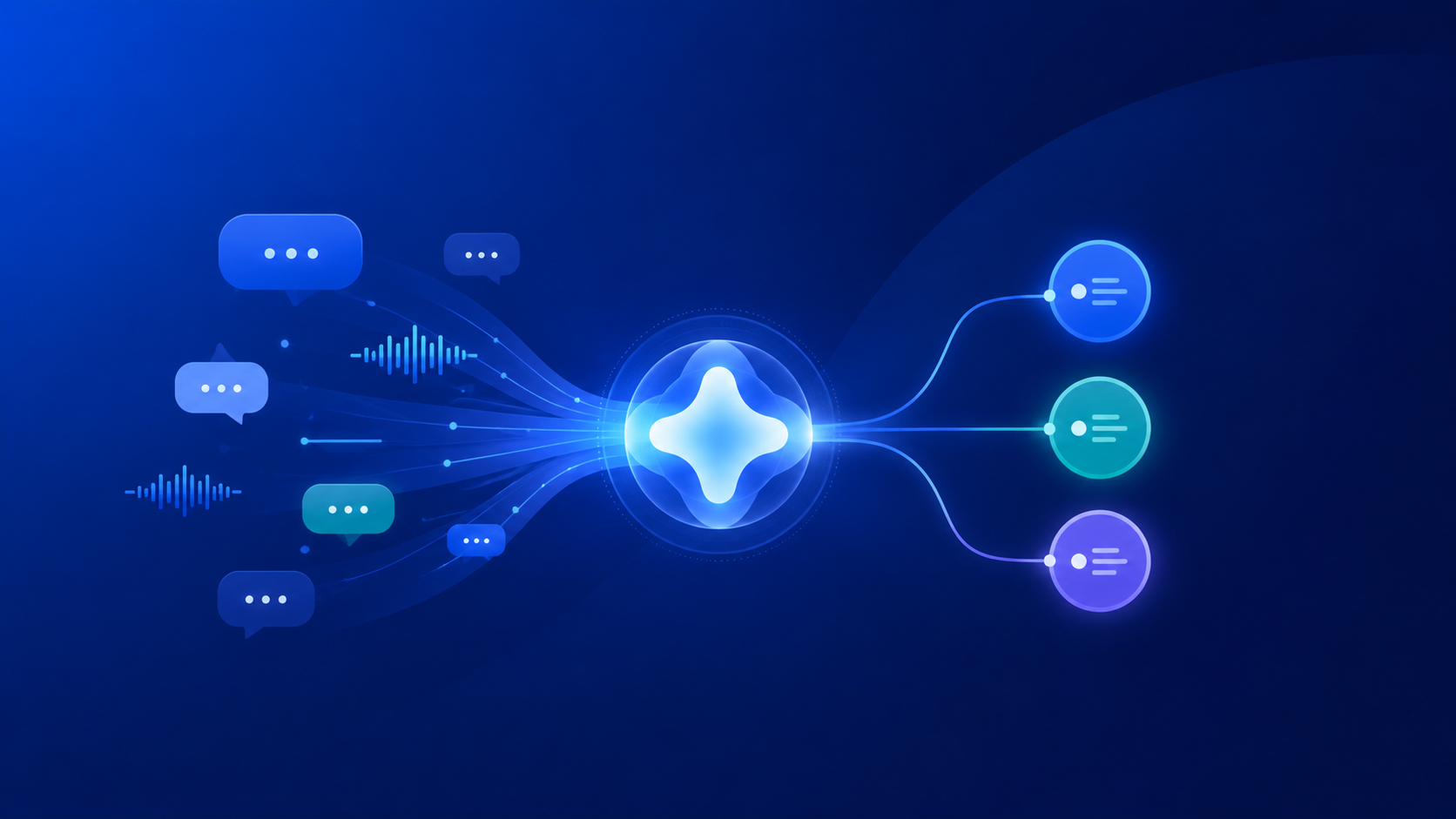
AI thematic analysis is the use of artificial intelligence to identify recurring themes, patterns, and root causes across qualitative data. It is especially useful when teams have too many interview transcripts, focus group discussions, open-ended survey responses, or customer conversations for a human team to code manually.
Traditional thematic analysis comes from qualitative research, academic research, and literature review workflows. Researchers read responses, create initial codes, compare patterns, and develop themes. Tools like NVivo, MAXQDA, ATLAS.ti, Looppanel, and other thematic analysis software can support that work. But the process can still take days or weeks when the dataset is large.
AI changes the cadence. With large language models, or LLMs, teams can classify, summarize, cluster, and synthesize qualitative inputs much faster. The result should not be a pile of labels. The result should be executive-ready insight: named themes, supporting quotes, root causes, severity, and recommended actions.
Why Thematic Analysis Matters for Frontline Businesses
Frontline businesses run on conversations. Guests explain what went wrong at check-in. Customers tell associates why they did not buy. Employees describe workarounds that keep service moving. Managers hear the same complaint repeatedly, but the pattern never makes it to senior leadership.
The challenge is scale. A COO cannot read hundreds of transcripts every week. A CX leader cannot personally review every mystery shopper debrief. A training leader cannot join every focus group. AI thematic analysis helps turn scattered conversation into a usable operating signal.
For Arbor, this is the core use case: Umi conducts AI-powered conversations with frontline employees, customers, guests, and mystery shoppers, then helps leaders understand what those conversations reveal.
How AI Thematic Analysis Works
The process does not start with a model. It starts with a business question.
1. Define the Decision the Analysis Needs to Support
Before using ChatGPT, Gemini, an internal generative AI model, or any other GenAI tool, define the outcome. Are you trying to understand why guest satisfaction fell? Why a new service model is not sticking? Which menu item creates confusion? Which process creates customer friction?
Without a decision, AI coding becomes a labeling exercise. With a decision, the analysis can rank what matters.
2. Collect High-Quality Conversation Data
AI can only analyze what you capture. Short survey responses may be useful, but they often lack context. Voice or text interviews that ask follow-up questions create better qualitative data analysis because respondents explain the reasoning behind their answers.
For example, “The check-in was slow” is a complaint. “The check-in was slow because the booking notes did not transfer, the room was not ready, and the front desk agent had to call housekeeping twice” is a root cause.
3. Use NLP to Structure the Raw Inputs
Natural language processing, or NLP, can help clean transcripts, detect sentiment, identify topics, and group similar statements. Machine learning and deep learning methods can support sentiment analysis, theme identification, entity recognition, and clustering.
In practice, leaders do not need to understand every data science method or compute tradeoff. They need confidence that the AI system can preserve nuance while making the data comparable.
4. Generate Themes, Root Causes, and Evidence
The analysis should produce more than “positive,” “negative,” and “mixed.” A useful output includes:
- A theme name written in plain language.
- The root cause behind the theme.
- The affected roles, locations, or customer segments.
- Representative supporting quotes.
- Severity and business impact.
- Recommended actions.
This is where AI agents can help. One agent may classify responses, another may check for contradictions, another may produce the executive summary, and another may validate whether evidence supports each finding.
5. Validate With Human Review
AI should speed synthesis, not remove judgment. Human review is essential for context, prioritization, and accuracy. A strong workflow uses triangulation: compare the AI output against transcripts, structured ratings, operational metrics, and stakeholder knowledge.
This is also where audit trails matter. Leaders should be able to trace a finding back to the underlying conversations and quotes. If the system says “booking-to-floor handoff is the root cause,” the team should be able to see the evidence.
The Risks of AI Thematic Analysis
AI thematic analysis is powerful, but it has risks.
Algorithmic Bias
If the dataset underrepresents certain languages, roles, shifts, or locations, the themes may reflect the loudest voices rather than the full reality. This is especially important for frontline teams where multilingual participation matters.
False Precision
A model may produce a confident summary even when the evidence is thin. This is why supporting quotes and audit trails are necessary. The output should show why a theme matters, not merely state that it exists.
Compliance and Privacy
Teams should consider GDPR, HIPAA, consent, data retention, and access controls when analyzing sensitive conversations. Healthcare, employee relations, and customer support use cases may require stricter review.
Overhyped Expectations
AI thematic analysis is not robotics, AGI, or magic automation. It is a practical application of artificial intelligence for qualitative research. Some teams may use fine-tuning for domain-specific language, but many can start with carefully designed prompts, secure workflows, and human validation.
What Makes an Output Executive-Ready?
Executives do not need a codebook. They need clarity. A good executive-ready analysis should answer five questions:
- What is happening?
- Where is it happening?
- Why is it happening?
- How confident are we?
- What should we do next?
A weak output says, “Service speed was mentioned 83 times.” A strong output says, “Service speed concerns are concentrated at weekend dinner shifts in Locations 2 and 4. The root cause is not staffing alone; employees consistently point to a new expo handoff that creates rework. Recommendation: revise the handoff protocol, retrain shift leads, and monitor the next two weekend waves.”
That is the difference between analysis and intelligence.
How Arbor Turns Conversations Into Intelligence
Arbor is built around the full workflow: create, listen, understand, and act. Umi helps design interviews, conducts conversations with real people, organizes every response into a library, and synthesizes findings into reports and recommendations.
For operations and customer experience teams, this means qualitative insight can move at the speed of the business. Instead of waiting weeks for a consulting deck, leaders can continuously hear what is changing across locations and act before the issue escalates.
Arbor’s approach is especially useful when teams need:
- Frontline employee voice across roles and shifts.
- Guest or customer journey insight.
- Mystery shopper conversations after specific touchpoints.
- Change diagnostics during rollouts.
- Executive-ready reporting grounded in real quotes.
A Practical Workflow for AI Thematic Analysis
Use this five-step workflow:
- Frame the business question. Tie the analysis to a decision, not a vague curiosity.
- Collect richer inputs. Use AI-moderated interviews or open-ended prompts that invite examples.
- Classify and cluster. Use NLP, sentiment analysis, and AI coding to find patterns.
- Synthesize for action. Turn themes into root causes, evidence, and recommendations.
- Validate and track. Use human review, triangulation, audit trails, and follow-up waves.
The goal is not to replace researchers. The goal is to help research, operations, and CX teams move from raw conversations to decisions faster.
Conclusion: Themes Are Only Useful When They Lead to Action
AI thematic analysis is not valuable because it finds words in transcripts. It is valuable because it turns conversations into decisions.
For frontline enterprises, the opportunity is enormous. The insights already exist in the conversations employees and customers are having every day. Arbor helps capture those conversations, synthesize the patterns, and deliver intelligence leaders can act on.
FAQs
Q: Can AI thematic analysis replace a qualitative researcher?
It should not replace judgment. AI can accelerate classification, synthesis, and quote retrieval, but humans still need to validate findings, understand business context, and decide what to do next.
Q: What data works best for AI thematic analysis?
Rich qualitative inputs work best: interview transcripts, focus group discussions, voice interviews, open-ended survey responses, and customer or employee conversations with enough detail to explain reasoning.
Q: How do you know the AI analysis is trustworthy?
Look for evidence. The system should provide supporting quotes, show audit trails, enable review of source transcripts, and allow findings to be compared against operational data.