
AI Survey Analysis for Open-Ended Feedback
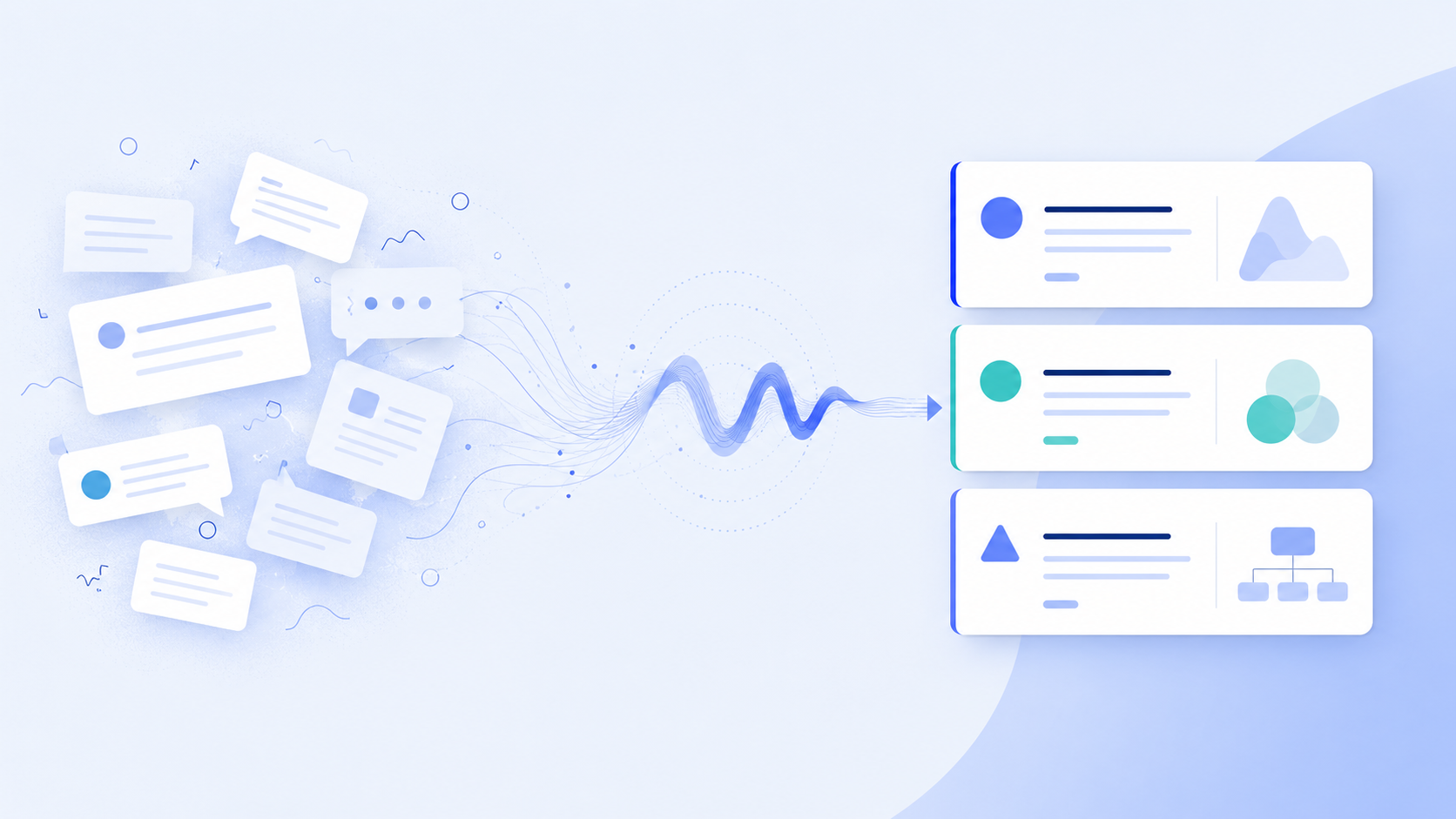
AI survey analysis is changing what research, customer experience, and operations teams can do with open-ended feedback. For years, survey data analysis meant exporting comments from employee listening programs, customer experience surveys, guest feedback, or mystery shopper programs, then asking a data analyst or research team to code responses by hand.
That work matters, but it is slow. A single NPS program can generate thousands of open-ended survey responses. Employee feedback programs can create even more unstructured text. Before leaders get actionable insights, someone has to clean the data, group comments, run sentiment analysis, compare segments, identify outliers, and decide which patterns actually matter.
AI can reduce that manual burden. But the best programs do not use AI to summarize feedback into generic labels. They use it to preserve context, connect themes to evidence, and help leaders understand what people actually said.
What AI Survey Analysis Does
AI survey analysis uses artificial intelligence, machine learning, natural language processing, and NLP techniques to interpret open-ended questions and open-ended survey responses. In a traditional workflow, a person reads each comment and applies codes. With AI, survey analysis software can classify responses by theme, detect sentiment analysis patterns, identify recurring issues, and compare findings across customer segments, employee groups, roles, regions, or locations.
The value is not just speed. It is structure. Open-text feedback often contains the “why” behind a score, but that “why” is hard to use when it lives across thousands of scattered comments. The right approach turns messy qualitative data analysis into a usable system of themes, root causes, supporting quotes, and recommended next steps.
The risk is assuming AI-assisted analysis is the same thing as insight. It is not. It is a workflow for converting qualitative data into a structure leaders can use. A strong workflow still needs good research design, clear governance, and human judgment. Teams should follow survey research best practices and use careful question wording guidance before they rely on any text analysis output.
Where AI Helps and Where It Falls Short
Generative AI can summarize comments, suggest themes, draft a codebook, identify repeated patterns, explain possible correlations, and turn findings into an executive memo. Used carefully, it helps market research, customer experience, and operations teams move faster.
But AI is not a complete research system by itself. A person still has to prepare the data, protect privacy, remove sensitive fields, decide whether the sample is reliable, and check whether the summary is grounded in the original responses. Survey data analysis can be accelerated with AI, but high-stakes customer or employee research still needs a traceable evidence trail.
A good workflow should let leaders move from synthesis back to the verbatim. If the AI says “training confusion is a root cause,” the team should be able to review the original comments, see which roles mentioned it, and verify whether the theme is widespread or concentrated in one location.
That is the difference between a useful insight and a polished summary.
The Manual Analysis Tasks AI Can Reduce
The first task is data processing. Before analysis, teams often need to remove duplicates, normalize fields, segment responses, and prepare comments for coding. AI can accelerate that work by detecting incomplete responses, inconsistent labels, and repeated patterns.
The second task is thematic analysis. Instead of starting with a blank spreadsheet, researchers can ask AI to propose themes, subthemes, and representative quotes. A human reviewer should still validate the structure, especially when the topic is sensitive or operationally complex.
The third task is sentiment analysis. Positive, negative, and neutral labels can help prioritize feedback, but sentiment should not be treated as the final answer. A comment can be neutral in tone and still reveal a severe process issue. A guest might calmly say, “We waited 25 minutes at the host stand,” while the operational impact is serious.
The fourth task is segmentation. Survey analysis software becomes more useful when open text is connected to structured fields like location, role, tenure, touchpoint, visit type, customer segment, or satisfaction score. This helps teams see whether a theme is universal or concentrated in a specific part of the business.
The fifth task is evidence selection. Leaders rarely act on a spreadsheet alone. They need a clear narrative, a ranked list of issues, and direct evidence that shows what people actually said. AI can help pull representative quotes, but teams should still review those quotes to ensure they are accurate, fair, and contextual.
How to Keep AI-Assisted Analysis Trustworthy
Start by separating collection from interpretation. A feedback form can collect structured responses. AI can help interpret the open-ended comments. But a trustworthy program needs governance across both stages.
Make sure the codebook is clear. Define each theme and give examples. Review outliers instead of deleting them too quickly. Keep verbatim evidence attached to every insight. Run human checks on sensitive findings. Compare AI themes against known metrics, but do not force qualitative feedback to fit an existing dashboard.
For market research teams, this matters because leaders often act on the story, not the spreadsheet. Researchers need to know whether AI preserved the participant’s meaning. For customer experience and operations teams, the danger is different: a system may label a theme as “service issue” when the actual root cause is staffing, training, inventory, equipment, or a broken handoff.
AI governance matters here. A practical research workflow should align with a risk-based approach, especially when feedback involves employees, sensitive experiences, or operational decisions.
Why Conversations Beat Static Open Text
Open-ended questions are better than multiple choice alone, but they still depend on the first answer someone gives. If a customer writes, “The checkout was confusing,” a static form usually stops there. An AI-moderated interview can ask, “What made it confusing?” or “At what step did the issue start?”
That follow-up is where AI-assisted analysis becomes AI-assisted research. Instead of analyzing only what people typed into a box, teams can collect richer responses from the start.
Arbor’s AI-moderated interviews use voice conversations to ask adaptive follow-up questions, then synthesize the results into themes, root causes, quotes, and recommendations. For a deeper look at this approach, read AI-Moderated Interviews for Customer Research.
This is especially useful when feedback comes from frontline employees, customers, guests, or mystery shoppers. These groups often have the detail leaders need, but they may not write long comments in a form. Voice gives them an easier way to explain what happened, and text analysis gives leaders a way to organize that detail without losing the original context.
How Arbor Turns Feedback Into Frontline Intelligence
Many organizations already collect scores. They know which location is underperforming, which touchpoint is slipping, or which team has lower engagement. What they often do not know is why.
That is where frontline intelligence matters. The people closest to the work often understand the operational reality behind the numbers. A server knows which part of a service model slows down the table. A front desk agent knows which guest handoff fails before check-in. A store associate knows which promotion customers misunderstand. A field worker knows which process creates repeat work.
AI survey analysis can help teams organize that feedback after it is collected. But the bigger opportunity is to collect better feedback in the first place. Leaders do not just need more data. They need the operational context that explains what is really happening on the ground.
This is also why frontline teams are such an important source of customer and market research. They hear how customers describe needs, objections, confusion, preferences, and frustrations in everyday language. Arbor explains that dynamic in How Frontline Teams Decode What Customers Actually Need.
Ready to Reduce Manual Research Work Without Losing Context?
Arbor is not just survey analysis software. Umi, Arbor’s AI researcher, conducts conversational interviews and turns the responses into executive-ready intelligence. That means leaders can ask a business question, collect structured and open-ended feedback, analyze the themes, and act on recommendations that are grounded in real conversations.
AI survey analysis is useful when it reduces manual effort. It is more powerful when it connects survey data analysis, qualitative data analysis, and frontline intelligence into one workflow. The best output is not a larger dashboard. It is a short list of actions leaders trust because every finding traces back to what people said.
Meet Umi to see how AI-moderated conversations can reduce manual analysis while preserving the voice, detail, and evidence behind every insight.
FAQs
Q: What is AI survey analysis?
AI survey analysis uses artificial intelligence to analyze survey responses, especially open-ended feedback, by identifying themes, sentiment patterns, recurring issues, outliers, and recommended actions.
Q: Can AI analyze survey data?
Yes. AI can summarize comments, draft themes, run text analysis, and explain patterns, but teams should still protect data, check the output against source responses, and preserve evidence.
Q: What is the difference between text analysis and thematic analysis?
Text analysis is a broad process for extracting meaning from text data. Thematic analysis focuses on organizing responses into themes that explain what people are saying and why it matters.
Q: Why are open-ended questions important for survey data analysis?
Open-ended questions let people explain the reason behind a score. They reveal friction, context, and root causes that multiple-choice questions often miss.